Posts

The murders, the mirror and the serpentines

Image
A detective called Erik Lönnrot is a man of prodigious intelligence; one of a type we love, and whom we imagine solving fiendish crosswords in minutes and secretly writing perfect sestinas and villanelles. He believes the solution to a murder is hidden in the arcana of ancient Hebrew theology. Perhaps through vanity, he throws out clues to his theory and modus operandi in a newspaper interview and names an obscure volume which an opportunist bookseller immediately finds and prominently displays. A second and a third murder (although the third in the series is perplexed by the absence of a corpse) seem to confirm his conjectures. But the interview, clues and the book have furnished the assassin with the means to construct the otherwise absent mystery for himself, and thus conduct Lönnrot through the second and third murders to the fourth, where the assassin gets a revenge which has eluded and frustrated him for years by shooting the detective. Lönnrot’s prosaic superior, Treviranus, has...

Hacking: a hack has his doubts

Image
Those of us who have rattled around a bit in the world of journalism know that there is a squad of freelances who dance along the margins of truth and legality to get whatever stuff they can and sell it in whichever marketplace will buy, sharing tricks and techniques as they go. That’s why I find it impossible to believe that the phone hacking scandal is confined to the News of the World and News International. The Guardian and the BBC would seem to want us to believe this is the case. But then, it feels like The Guardian has cast itself as a virtuous newsprint Perseus on a mission to behead the evil Murdoch Medusa, while the BBC has loathed News International ever since Rupert Murdoch, in a surprisingly nervous performance (which I witnessed) at the Edinburgh TV Festival in 1989 delivered a MacTaggart lecture in which he denounced the then TV establishment as “an integral part of the British disease” and made it clear that he detested the licence fee as an anachronism and a brake on f...

Work this one out

Image
Signed up this week for the new Government on-line service which advises when suitable contracts are coming up. To ensure relevance, you key in some search terms. Mine were, alphabetically arranged: Brand, Communications Skills, Conferences, Internal Communications, Marketing, Video Production. My first suggested contract arrived this morning: Remediation of well, St James Park – These are works which proceed from the clearance and pump testing of a well on Duck Island in St. James’s Park, Westminster. The works are to make permanent the temporary works so far carried out, to install a steel casing and pump within the well and to provide a permanent single duty and single point of discharge to the lake. Summer’s coming, and as you can see, it’s a pretty little place. Charles I walked beside the lake between breakfast and execution. As it happens, I was thinking the other day of writing a story in which the twist is John Milton realising and confessing to Charles II that the two groans ...

What we were fighting for... (a tree-hugger’s postscript)

Image
What do we know? You walk past a tattered old tree. If you see it at all, you think, “there’s a tattered old tree.” Transpires you’re walking past 1500 years of birdsong, war, poetry, tobacco-smoke, exile, failure and hope. Could be any old tree, near any of us. Demolishable in less than hour to save a few quid for David Cuckoo-Clock and Nick Clogg. High above London grows a solitary fir tree – this one – the last of a stand that was planted in 1745 by William Turner, a retired tobacconist whose business was (where else?) in Fleet Street. Already, Turner’s pines were more than half a century old when John Keats saw them while rambling on Hampstead Heath as a medical student, looking for medicinal herbs with his tutor, William Salisbury. William Blake must have walked past them on his way to Sunday lunch with John Linnell (maybe the firs are visible in the background of this picture by Linnell of the ageing visionary, poet and painter on the Heath?). Byron and Shelley and Coleridge woul...

Tories felled by Forest Thump

Image
Like Bottom before him, David Cameron wandered into the woods and got turned into an ass. Seems Oberon is still around, and doesn’t discriminate between a rude mechanical and a smart-arse plutocrat. It isn’t just that the woods won. They always must. What surprised me was the totality of the surrender and the speed of the victory. I’ve written before about the cultural and emotional resonance of the woodlands. Thinking a little more around the theme, I begin to understand that for a people with such a bruised, retiring and secretive sense of nationhood as the English, certain things will have animating force; that when the symbolic and the actual are united in a single phenomenon, as they are in these ancient woods, an extraordinary vitality will exist – which we’ve just seen uncorked. Coole House in Ireland, the home of Lady Gregory, was clearly once such a place. Why else was it destroyed? But Coole’s Seven Woods remain, and I’ll leave it to an Irishman (an Anglo-Irishman) who used...

The meaning of the movement in the woods

Image
Round one, then, goes to our nationwide army of tree-huggers. But if you study the detail, you’ll see that rounds two, three and onwards are still to be fought. True, the Government has started to back away from the indiscriminate sale and enclosure of our woodlands. But this weekend’s concession applies to just 15 per cent of forestry. The remaining 75 per cent is still - unless our pressure is sustained and successful – heading for the auctioneer’s hammer and thence to the barbed wire and chainsaws of privatisation (Mary Creagh explores background and jeopardy in her Guardian piece from February 11). If you’ve been following the campaign websites of the Woodland Trust and 38-Degrees you’ll have observed that whenever a target was set on a particular day for a new total of petition signatories it was almost always exceeded. Thinking, in the couple of weeks since I last blogged on the subject, about this extraordinarily vigorous response, I remembered a book I’d read back in 1998. Ca...

At the court of public opinion

Image
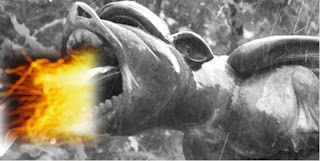
And lo! I found myself in a great vaulted court, upon the bench of which crouched a monster whose limbs shook incessantly, and whose face was bloated and twisted and black. And from his flabby mouth, each time he exhaled, issued a myriad sparks, which were drenched to cinders by the bile that followed them, and fell upon the granite blocks of the walls and on the beams and ceiling, and on the furnishings and on the floor, which was a sea of hissing, creaking clinker, while everything else besides was vanishing under a film of soot. And I said to the demon at my side, who was naked except for a pork pie hat, and scratching himself, “what manner of creature is this?” And he replied, “The name of the monster is ‘Opinion,’ and his time is the last winter of the living language. In his realm there is no tender thought that goes untrampled, no guilty dream that is not seized and turned out of doors to be pilloried, no doubt or difficulty that passes unreviled.” And as I listened and watched,...